Journal of First-generation Student Success
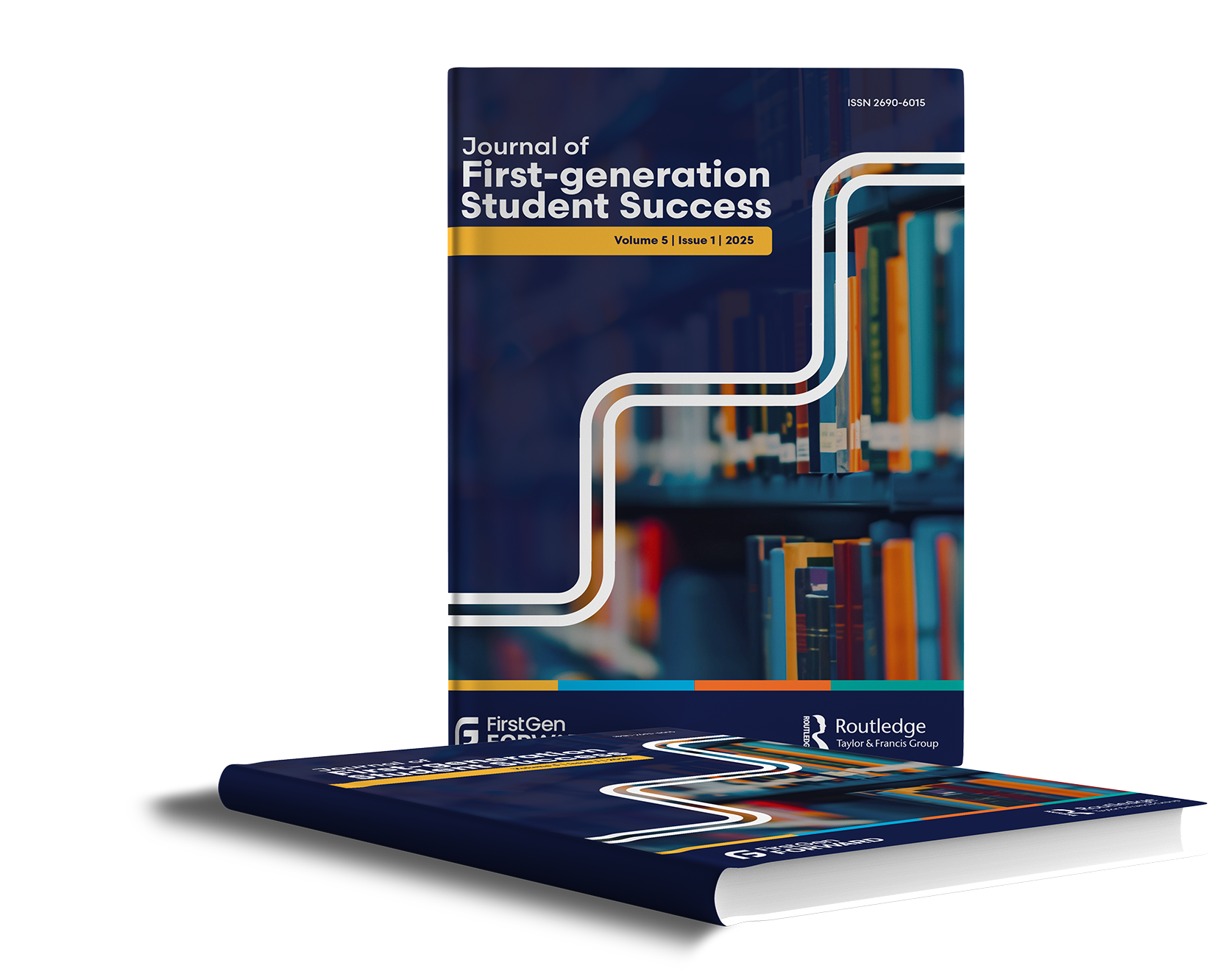
The Journal of First-generation Student Success accepts practice-based articles grounded in research and literature and, reciprocally, research articles that speak to practice. While traditional scholarship will be encouraged and accepted, articles prioritizing innovative solutions and advanced thought that dispute deficit-based conversations while propelling an asset-based, evidence-driven national narrative, are welcome.
Through the deep intersectionality of the first-generation identity, the large presence of first-generation students at institutions, and the necessary engagement of both academic and student services areas for success, this journal offers many opportunities for cross-disciplinary collaboration.
The Journal of First-generation Student Success joins other NASPA—Student Affairs Administrators in Higher Education publications and is a NASPA member benefit.
NOW AVAILABLE!
Latest Issue
The latest Journal of First-generation Student Success issue is now available online.
Volume 6: Issue 2
-Providing-26-years-of-Academic-and-Social-Support-to-Appalachian-Youth-in-West-Virginia.jpeg)
Research Articles
Understanding First-Generation and Continuing-Generation Graduates’ Decisions to Pursue PhD Programs in Biological Science
Compared to continuing-generation bachelor’s graduates (CGGs), first-generation bachelor’s graduates (FGGs) are underrepresented in U.S. STEM PhD programs. To better understand how students choose to pursue PhDs, we analyzed interview data from 62 FGG and CGG first-year PhD students in bioscience.

Research Articles
Encouraging a Growth Mindset: The Influence of Classroom Goals on Engineering Students’ Growth Mindset at a Hispanic-Serving Institution
This study examined the impact of classroom goals, personal achievement goals, and the experience of a mastery learning course on the growth mindset of 148 engineering students. We evaluated how students’ growth mindset changed as a function of the learning environment and their personal achievement goals.

Research Articles
Perceived Social Support and Learning Engagement Among First-Generation College Students in China: The Mediating Role of Positive Psychological Capital
A strengths-based approach explored how First-generation College Students (FGCSs) utilize external resources (e.g., social support) and internal resources (e.g., psychological strengths) for higher education engagement.

Research Articles
“We Don’t Know These Answers. We Don’t Know Where to Go”: The Experience of First-Generation College Student Mothers
Parents are integral aspects of their children’s psychoeducational experiences, and their support is a critical component of student success. However, research focusing specifically on the unique experiences of the parents of first-generation college students has been scant. Thus, using a qualitative phenomenological approach, the current study explores the experiences of Parents of First-Generation College Students (PFG).

Notes From the Field
Employing Augmented Reality to Foster Sense of Belonging for First-Generation College Transfer Students Transitioning to a Four-Year University
It is imperative that higher education offer critical resources that support the growing number of first-generation college transfer students. This Notes from the Field examines one strand of this imperative from the perspective of employing Augmented Reality (AR) to foster a sense of belonging.

Notes From the Field
Beyond Deficit Thinking: Six Strategies for Faculty Mentors of First-Generation, Poor, and Working-Class Graduate Students
Literature on first-generation, poor, and working-class (FGPWC) students is increasing but limited, especially at the graduate level. This article highlights the experiences of FGPWC graduate students and the critical role of faculty mentoring.
Edition Cost
Individuals: $141 (print and online)
*Local tax will be added as applicable
Institutions: $383 (online); $548 (print & online)
*Local tax will be added as applicable
*Access to JFGSS is a NASPA member benefit.
Editorial Leadership

Kem Saichaie, Ph.D.
Co-Editor
Inaugural Executive Director, UCLA Teaching & Learning Center (TLC), University of California, Los Angeles

Jason K. Wallace, Ph.D.
Co-Editor
Associate Professor, Mississippi State University

Lamesha C. Brown, Ph.D.
Associate Editor
Director of the College Achievement Program, University of Pennsylvania

Radomir Ray Mitic, Ph.D.
Associate Editor
Assistant Professor, William & Mary
Michelle Rossi, Ph.D.
Editorial Assistant
Graduate Student Researcher, University of California, Davis

Rashné Jehangir, Ph.D.
Founding Editor Emeritus
Professor of Higher Education and Assistant Dean of Education Opportunity Program; Robert H. Beck Chair of Ideas, University of Minnesota—Twin Cities
Submissions
The Journal of First-generation Student Success (JFGSS) accepts manuscripts that offer new and innovative perspectives and interventions in the context of the postsecondary success of first-generation students. The Journal contributes to the scholarship of those in the higher education field seeking a research-based approach to best practices and practitioners interested in utilizing research to inform their work.
Researchers, practitioners, education leaders, college access partners, and doctoral candidates are invited to submit manuscripts of original work conducted by the submitting author(s). Proposed work or simple conceptualizations of issues are not accepted. Manuscripts under review by JFGSS should not be under consideration by other journals.
The Journal accepts submissions on a rolling basis and is published three times per year, in April, August, and November.
AI-based Tools and Technologies
JFGSS advocates for responsible use and acknowledgement of GenAI usage. Please view the summary of Permitted AI, which articulates the use and declaration requirements for manuscript preparation. Upon article submission, authors will be asked if they have read and agree to the above policy. Invited reviewers receive a reminder about the same policy.
Submission Guidelines
Review Process
Submissions to the Journal of First-generation Student Success are accepted on a rolling basis. All manuscripts are subject to a closed, peer-review process (this language reflects a shift to employ inclusive language rather and move away from the industry term “blind review”). Once submitted, the first author will receive confirmation that the submission has been received. Authors are able to track the progress of their submissions in the ScholarOne system.
Reviews may take up to four weeks, or longer, depending on the volume of submissions. Please see the Submission Guidelines section for greater detail on submission types, review process, and technical requirements. For more information, please contact the Editorial Leadership at jfgss@firstgenforward.org.
Editorial Board
2024-2027 Term
Florencia Cornet, Ph.D., University of South Carolina
Lisa Cullington, Ph.D., Sacred Heart University
Carolina E. Gonzalez, Ph.D., Bank Street College of Education
Casandra Harper, Ph.D., University of Missouri
George Pacheco Jr., Ph.D., West Texas A & M University
Pietro Antonio Sasso, Ph.D., Delaware State University
Blake R. Silver, Ph.D., George Mason University
Matthew Joseph Smith, Ph.D., Valdosta State University
Jennifer Trost, Ph.D., University of Minnesota Twin Cities
Chevella Wilson, Ph.D., Northern Virginia Community College
2025-2028 Term
Roshaunda Breeden, Ph.D., North Carolina State University
Brett Bruner, Ed.D., Wichita State University
Antonio Estudillo, Ph.D., Heritage University
Leslieann Harris, Ed.D., Georgia Southern University
Rocio Hernandez, Ed.D., Ventura College
Amber Holton-Thomas, Ph.D., Pacific University
Natasha Hutson, Ed.D., Agnes Scott College
Lorie Kittendorf, Ph.D., The University of Tampa
Sarah Madsen, Ph.D., Baylor University
Dennis McCunney, Ph.D., East Carolina University
Delma Ramos, Ph.D., University of North Carolina at Greensboro
Jessica Saint Amour, Ph.D., Grand Valley State University
Geneva Sarcedo, Ph.D., University of Colorado Denver
Margaret Sebastian, Ph.D., Salisbury University
Krista Soria, Ph.D., University of Idaho
Michael Sparrow, Ed.D., Morgan State University
Susan Taffe Reed, Ph.D., Dartmouth College
Charmaine Troy, Ph.D., Georgia Institute of Technology
Rashim Wadhwa, Ph.D., Akal University, Bathinda, India
Mary Wallace, Ph.D., University of Alabama Birmingham
Tiffany Wiggins, Ph.D., University of North Caroline at Chapel Hill
Soua Xiong, Ph.D., California State University, Fresno
2026-2029 Term
Karen Archambault, Ed.D., Rowan College at Burlington County
Sonja Ardoin, Ph.D., Clemson University
Lamesha Brown, PhD., University of Pennsylvania
Suzanne M. Buglione, Ed.D., Johnson & Wales University
Amy Collins-Warfield, Ph.D., University of Minnesota Rochester
Yasmine Dominguez-Whitehead, Ph.D., University of California, Santa Barbara
Meghan Ecker-Lyster, Ph.D., University of Kansas
Martha Enciso, Ed.D., University of Redlands
Amy Goodburn, Ph.D., University of Nebraska - Lincoln
Quortne Hutchings, Ph.D., Northern Illinois University
Tara Hornor, Ph.D., Citadel Military College of South Carolina
Jillian Ives, Ph.D., University of Connecticut
Karen Jackson, Ed.D., Georgia Gwinnett College Beth Nahlik, Ph.D., Kent State University
Akalya Kandiah, Ph.D., McMaster University
Georgianna Martin, Ph.D., University of Georgia
Robert Martinez, Ph.D., William & Mary
Graziella Pagliarulo McCarron, Ph.D., George Mason University
Nicole Pulliam, Ph.D., Monmouth University
Chandra Reyna, Ph.D., Boise State University
Erin Richman, Ph.D., University of North Florida
Ashley Rondini, Ph.D., Franklin & Marshall College
Jeanette Ruiz, Ph.D., University of California-Davis
Laura Wagner, Ph.D., RN, FAAN, University of California, San Francisco
Huanshu Yuan, Ph.D., Marshall University
Call for Editorial Board Members
Editorial Board members contribute to the review and selection of journal articles. Applications are closed for the editorial board members to serve on the 2027-2030 board!
Frequently Asked Questions
How do I submit my manuscript?
- All manuscripts must be submitted via the Journal of First-generation Student Success submission site, ScholarOne. Submissions will not be accepted by individual editors, editorial board members, or FirstGen Forward staff. Links to the submission site are also found on FirstGen Forward’s Journal webpage.
- The JFGSS publisher, Taylor and Francis, offers a robust website for author support. The website includes a Review Guide, video library, YouTube Channel, and Frequently Asked Questions section which allow you to access information in your preferred delivery mode and at your convenience. For technical assistance with the ScholarOne submission portal, please contact the Taylor and Francis support team.
How do I find guidelines or instructions for authors for my manuscript?
Submission Guidelines are outlined on the Journal for First-generation Student Success website.
What if I have a specific question about my proposed submission?
In order to accurately track and respond to questions about submission topics or types of manuscripts, please email jfgss@firstgenforward.org. Please note the Co-Editors and Editorial Board members have been directed to forward any direct inquiries to jfgss@firstgenforward.org to ensure that consistent responses are provided.
What types of submissions will the Journal accept?
- JFGSS is interested in publishing innovative, interesting, and relevant articles that span the full range of possible forms. Please consider the following suggested manuscript types to convey your topic:
- Theoretical Manuscripts,
- Review Manuscripts,
- Empirical Research Articles,
- Book Reviews, and
- Notes from the Field.
- Any and all of the following manuscript types can be utilized in sharing knowledge about first-generation student success. This delineation of manuscript types is not meant to limit but rather assist you in crafting a manuscript that is successfully reviewed and published. More details about the submission types are provided in the Submission Guidelines.
When will I know if my article has been accepted? What happens next?
An acknowledgment email will be sent to the first author as confirmation that the submission has been received in the system. The Editors and Editorial Board will review submissions on a rolling basis as received. The review process may take from four to six weeks to receive a response based on current information; this estimate may vary depending on reviewer and editorial team capacity. Authors will be able to track the progress of their manuscript by logging into the submission site, ScholarOne.
Who is the JFGSS audience?
JFGSS accepts articles that are relevant to faculty, researchers, scholars, student affairs educators, and academic leaders. Not all articles will speak to all constituencies all the time. The Co-Editors are committed to publishing an array of articles that, at various points, will speak to all educators who work in both the academic and student affairs areas of higher education.
How do I become a reviewer or editorial board member?
Applications for Editorial Board positions typically open on or about August 1 and close on October 1. Those interested in serving as reviewers can contact jfgss@firstgenforward.org, and a member of the editorial team will reach out. Reviewers and editorial board members must have terminal degrees.