Are We Offering Support or Building Belonging?
At Southwest Mississippi Community College (SMCC), our work with first-generation students has led us to rethink a simple question: are we offering support, or are we building belonging?
I know they are both important, but stay with me for a moment.
Imagine you are an 8-year-old student in second grade and you just found out your parents are moving with only a few weeks left in the school year. You pack up and move hours away to a new town, a new school, and a new home. On your first day, you walk into that new school. How are you feeling? Scared, nervous, sad, maybe even a little hopeful?
The counselor and principal make sure you are placed with a kind teacher. You have a safe classroom. You have everything you need to succeed academically.
Do you feel supported? Probably.
But do you feel like you belong?
That is the difference.
Like many institutions, we have invested heavily in tutoring, advising, and early alerts. These are important and necessary supports, but over time, we began to recognize something deeper. Our students were not struggling because support was unavailable. Many of them were struggling because they had not yet found a sense of belonging.
That realization changed the way we approached our work.
Starting with Connection
I am going to be real for a moment. Prior to joining NASPA, I did not have a strong understanding of what it truly meant to be a first-generation student. That changed when a colleague and I attended a session at the SSHE conference in Anaheim, California.
During the session, we were asked to raise our hands if we were the first in our family to attend college. My colleague and I looked around the room and quickly realized we were the only two who did not raise our hands. We just looked at each other and said, “Wow.”
Then the stories started.
One by one, these incredible individuals shared their experiences, and it was both humbling and inspiring. They talked about their journeys, their challenges, and the ways their institutions were supporting first-generation students. As they shared data from their campuses, I had another realization. When they mentioned the percentage of first-generation students at their institutions, I knew ours was higher.
Much higher.
Our grant data shows that 84 percent of our students are first-generation. Eighty-four.
In that moment, it became clear that we had work to do. We needed to better understand our students and how to support them.
Support.
There is that word again.
You might be thinking, “I thought this was about belonging.” Stay with me for a moment.
When we returned to Mississippi, we shifted our focus to how our students actually experience college. We became more intentional about how we reach and communicate with them.
Our students love our EdSights chatbot, Charlie the Bear. He checks in on them, plays trivia, and gives them a space to share their thoughts through text messaging, which just happens to be their preferred way to communicate.
In many cases, this is the first time a student has been asked how they are really doing in a way that invites an honest response.
Those conversations open the door for students to ask questions they might not otherwise feel comfortable asking. More importantly, they give us another way to connect students to the support and community around them.
But as we listened more closely, we began to notice a pattern. Students knew support was available. Many of them had even used those services at some point. What they were missing was not access.
It was belonging.
Through those conversations, students shared that they often felt like they were figuring everything out on their own. They did not always see themselves reflected in the college experience, and they were not always sure where they fit.
That realization helped us understand something important. Support may help students succeed, but belonging is what helps them stay, grow, and fully engage in their college experience.
When Small Barriers Feel Big
As we began having more honest conversations with our students, we kept hearing the same thing. Several shared that they had seriously considered leaving college over one or two missed assignments. Not because they lacked ability or motivation, but because they truly believed there was no way to recover. They would see a zero in Canvas and assume they had already failed.
Without someone in their immediate circle who has navigated college, they did not realize they could talk to their instructor, ask questions, or work toward a solution. For many of them, that option simply did not feel available.
What stood out most was not the missed assignment. It was the isolation behind it.
Once those conversations happen, everything begins to shift. Students start to see that challenges are part of the process, not the end of it. More importantly, they begin to feel like they are not figuring it out alone.
NextGen Navigators
All of these conversations led us to a bigger question. If students knew support was available but still did not feel like they belonged, what would it look like to create something that focused on that missing piece?
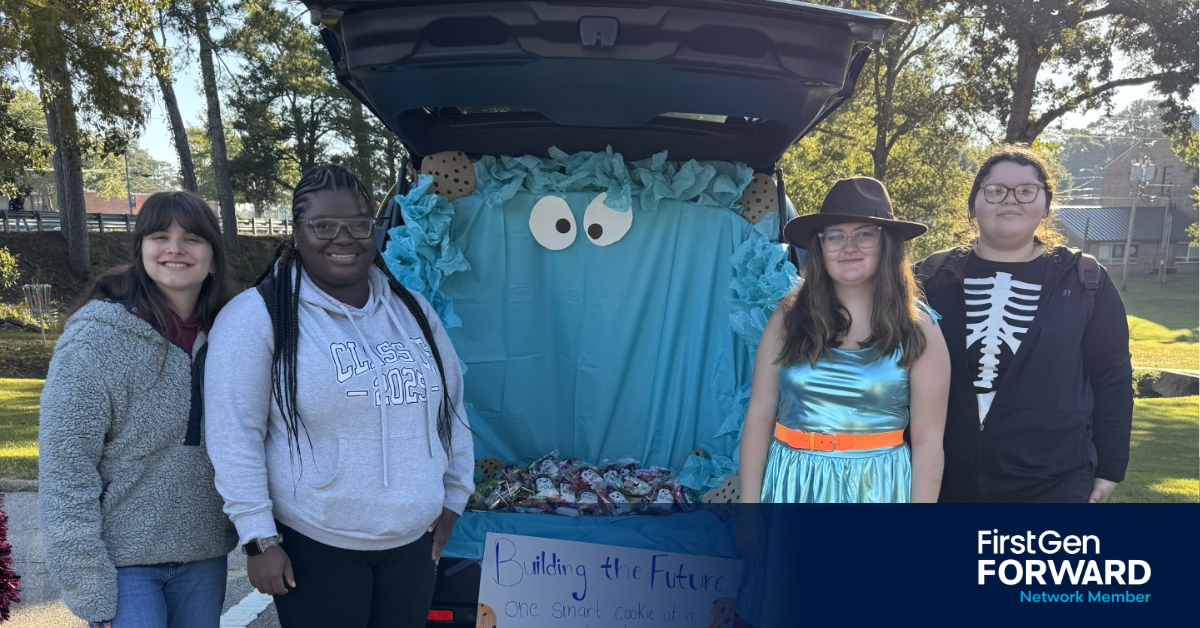
That question became the foundation for NextGen Navigators, our first-generation student group.
We knew we needed to create a space where students could build confidence, form connections, and begin to see themselves as part of the college community.
The direction of the group was shaped directly by what our students were telling us. They wanted to feel more connected, understand how college works, and get involved. They just were not always sure where to start.
Through this group, students have opportunities to talk openly about their experiences, connect with peers who understand their journey, and learn how to navigate college in ways that may not be obvious to them at first. It also serves as a starting point. As students grow more confident, many of them begin exploring other organizations, leadership roles, and opportunities across campus.
What began as a response to a gap has become a space where students can grow, lead, and feel like they belong.
Why Belonging Matters
When students begin to feel connected, you can see the difference in how they engage with their college experience. They start showing up to tutoring more consistently, communicating more openly with their instructors, and continuing forward even when things get difficult.
One student shared, “I didn’t know that I could go to my instructor and ask for help. My math instructor let me come in her office to do my work so she could see what I was missing. I feel so much better about college now.”
Moments like this are a reminder that this kind of growth does not come from a flyer or a reminder email. It comes from relationships and from students feeling like they are not navigating college on their own.
Bringing It Back to Belonging
Through this work, we have learned that supporting first-generation students is not just about expanding services. It is about creating spaces where students feel seen, valued, and supported.
Our students bring resilience, determination, and a strong sense of purpose.
Our role is to create an environment where those strengths can grow. Every institution offers support in some form or fashion, but not every institution creates belonging.
We continue to ask ourselves a simple but important question:
Are we building programs students can attend, or communities they do not want to leave?
For first-generation students, that difference matters.
/FGCC%20Blogs/2026%20State%20Proclamation.png)