Alabama A&M University began with a bold and deeply personal vision. William Hooper Councill is the university’s founder and a formerly enslaved man. He imagined a college for Black people at a time when such an idea was both radical and necessary. His belief in education was not about individual advancement alone—it was about opening doors for generations to come. In many ways, his vision was first-generation at its core: creating opportunity for students who would be the first in their families to claim education as a right rather than a privilege.
By deepening our first-generation engagement, students, staff, and alumni are seeing that Dr. Councill’s legacy shows up every day on our campus.
Today, 38% of Alabama A&M University’s students identify as first-generation. These students are not concentrated in one corner of campus or one academic pathway. They are international students, neurodivergent students, transfer students, student leaders, student scholars, and student parents. They are first-year undergraduates and doctoral candidates. Together, they reflect the original purpose of the institution—access, persistence, and possibility.
First-Generation Identity as a Strength
Viewing first-generation student success through an HBCU lens requires a shift in posture. Rather than asking what first-generation students lack, we ask instead how AAMU can celebrate their identities and support their needs.
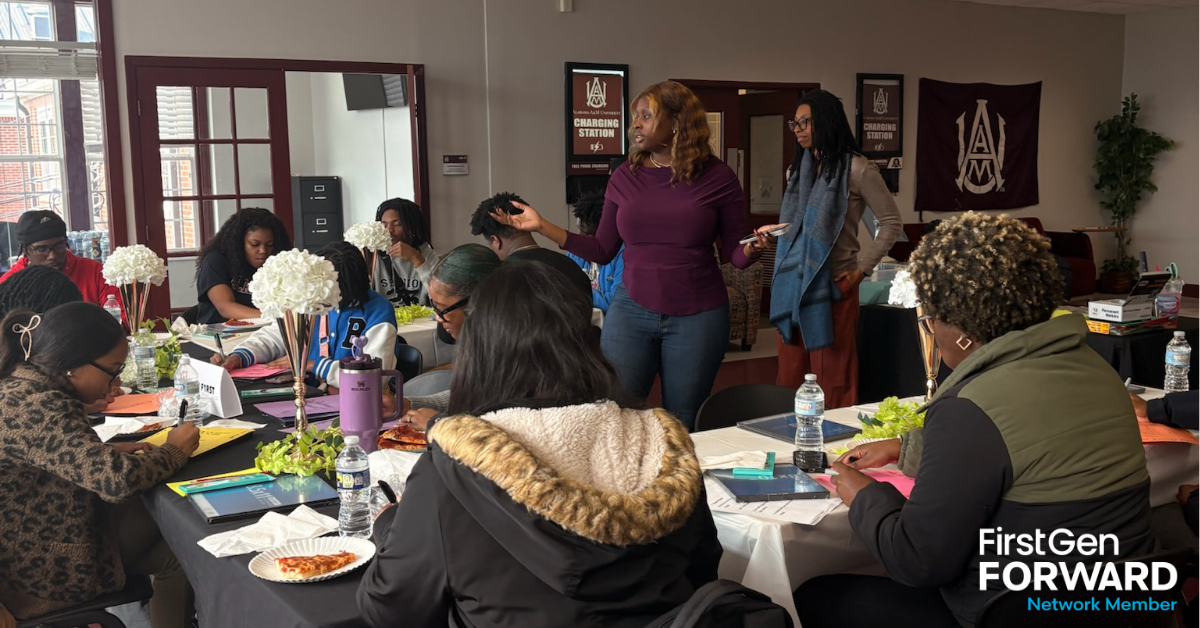
With this perspective, our work became less about fixing students and more about building a supportive community. The Monthly First-Gen Lunch & Learn series was designed as a space for conversation rather than instruction. First-generation faculty, staff, and alumni join students to talk honestly about navigating higher education, careers, and identity. Each session also included guided mental health and grounding practices—small but meaningful acknowledgments of the emotional labor that often accompanies being first-generation.
One student captured it best: “My education is a responsibility—not only to myself, but to my family and my community.”
Community, Collaboration, and Visibility
At Alabama A&M University, relationships matter. Faculty, staff, and alumni who identify as first-generation graduates served as guest speakers and mentors, offering transparency about their own paths. In partnership with Athletics, the Office of Student Leadership & Engagement hosted a First Generation Tailgate during a men’s basketball game. The setting was intentional—placing first-generation identity in a high-energy, highly visible campus space where community naturally gathers.
During First-Gen Bulldogs Week, the university also hosted a Celebration Brunch and recognized our first annual First-Generation Essay Award recipients. Scholarship applications revealed stories of family sacrifice, persistence, and purpose. One applicant wrote, “Being first-generation means I’m not just doing this for myself. Every step I take forward makes it easier for the people coming after me.”
Carrying the Vision Forward
William Hooper Councill did not imagine education as a finish line. He imagined it as a beginning. When first-generation students thrive at Alabama A&M University, they are not defying the odds—they are fulfilling a vision set in motion long before them.
By grounding first-generation efforts in history, community, and accountability, HBCUs can continue to support students in ways that feel authentic and sustaining.
Learn more about Alabama A&M University's first-generation initiatives here.

/FGCC%20Blogs/2026%20State%20Proclamation.png)